
magine you are sitting in an interview tomorrow. The hiring manager leans forward and asks:
“How are you currently using AI in your project management work?”
You’ve been experimenting with Copilot and Claude for basic tasks. Which of the following answers best signals that you understand where AI is headed in the PM space?
A) “I use Copilot to summarize emails and generate first drafts of status reports.” B) “I’ve started connecting AI tools to live data sources like email and documents, and I’m exploring how agents can automate repetitive PM tasks like risk register updates, so I can focus on decisions that need human judgment.” C) “I understand the underlying concepts, like RAG, context windows, and token cost, well enough to evaluate AI use cases and speak intelligently about agentic delivery models with technical teams.” D) “I’ve completed the PMI AI in project management certification and follow AI developments closely.”
Keep your answer in mind. We’ll reveal the best choice at the end.
The Quiet Room: A Glimpse into the Future of PM
Midway through a training session this week, a participant connected Claude to his Gmail, uploaded a risk register, typed a single prompt, and watched the tool scan his inbox, identify project issues, and populate the spreadsheet automatically.
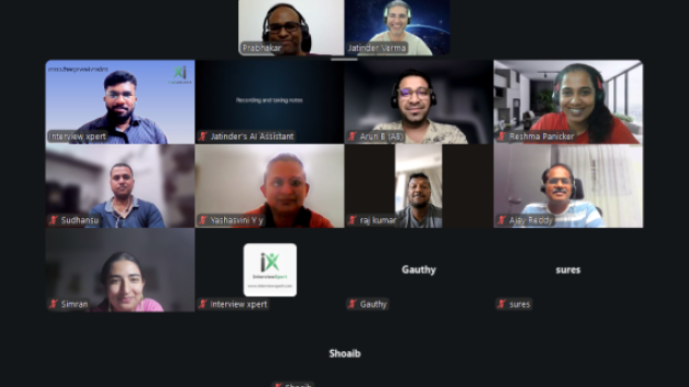
He hadn’t written a single line of code.
For a moment, the entire room went quiet. If you are a project or program manager, that quiet is worth paying attention to. It represents a fundamental shift in how work gets done.
The AI Gap: Using vs. Orchestrating
The session highlighted a distinction that sounds small but is actually career-defining: there is a massive difference between using AI and being able to talk about it intelligently in the rooms where it matters.
Job descriptions are already shifting. Scrum masters, program managers, and transformation leads are being asked to do much more than just use AI tools. They are being asked to:
- Evaluate AI use cases.
- Understand the ROI on token costs.
- Lead adoption initiatives.
- Work alongside or orchestrate AI agents.
The industry is moving toward an “agentic delivery model.” AI is no longer a side tool; it is becoming embedded across the entire project lifecycle.
Here is the reframe: most mid-to-senior professionals are still treating AI as a simple productivity add-on—something to help you write faster or summarize quicker. But if your team is working on an AI use case and someone mentions that the “model layer” is failing, you need to know what a model layer is. You don’t need to know how to code it or fix it, but you do need to know enough to lead the room.
Understanding terms like tokens, embeddings, RAG (Retrieval-Augmented Generation), and context windows isn’t about becoming a developer. It’s about ensuring you aren’t just nodding along while others drive the conversation.
The real gap in the market isn’t between people who use AI and people who don’t. It is between people who can talk about it with precision and people who cannot. And that gap is showing up in interviews right now.
The Honest Mirror
Look in the mirror and ask yourself: If you were asked in an interview tomorrow to describe how AI is being used in your organization and what your role has been, would your answer reflect genuine familiarity with the landscape? Or would it be a polished version of “I use Copilot sometimes”?
Recent data points show that only 20% of the workforce currently claims to have good AI skills. The question is which side of that number you are on, and more importantly, whether you can prove it when the pressure is on.
The Reveal: So, Which Answer Was Best?
Let’s look back at our opening quiz.
Both B and C capture real insight, but C is the stronger answer.
Why? Because it demonstrates the specific, high-level literacy that organizations are desperately looking for. Knowing the terminology, understanding what RAG or context windows actually mean, and being able to discuss token costs and system design at a high level allows you to lead AI teams rather than just participate in them.
Answer C signals that you are not just a user; you are someone who can orchestrate.
Ready to Take the Next Step?
If you want to practice structuring answers like C under actual interview pressure, that is exactly what OASIS is designed for. Visit interviewxpert.com to start turning your interview answers from “We’ll be in touch” to “Welcome aboard.”
Want to build the skills to back it up? If you’re ready to take your AI skills beyond basic experimentation and apply them to real-world project and program management, join our AI-Driven Project & Program Management Workshop.
It’s a 2-day, hands-on live workshop covering AI for project planning, risk management, decision-making, productivity, and execution.
- When: October 3–4 | 10 AM – 6 PM
- Format: Live cohort | Limited to 10 participants
It’s a focused opportunity to build practical AI capabilities you can take straight into your PM role—and your next big interview.
– Jatinder